
Watch: Advanced Photonic Crystal MEMS Resonator Modeling and Eigenfrequency Analysis Coupled Optical and Mechanical Simulation Using COMSOL Multiphysics
The project video starts automatically in muted mode where the browser permits autoplay. Use the player controls to enable sound, pause, seek or replay while reviewing the model workflow and simulation results.
Simulation Images and Output Snapshots
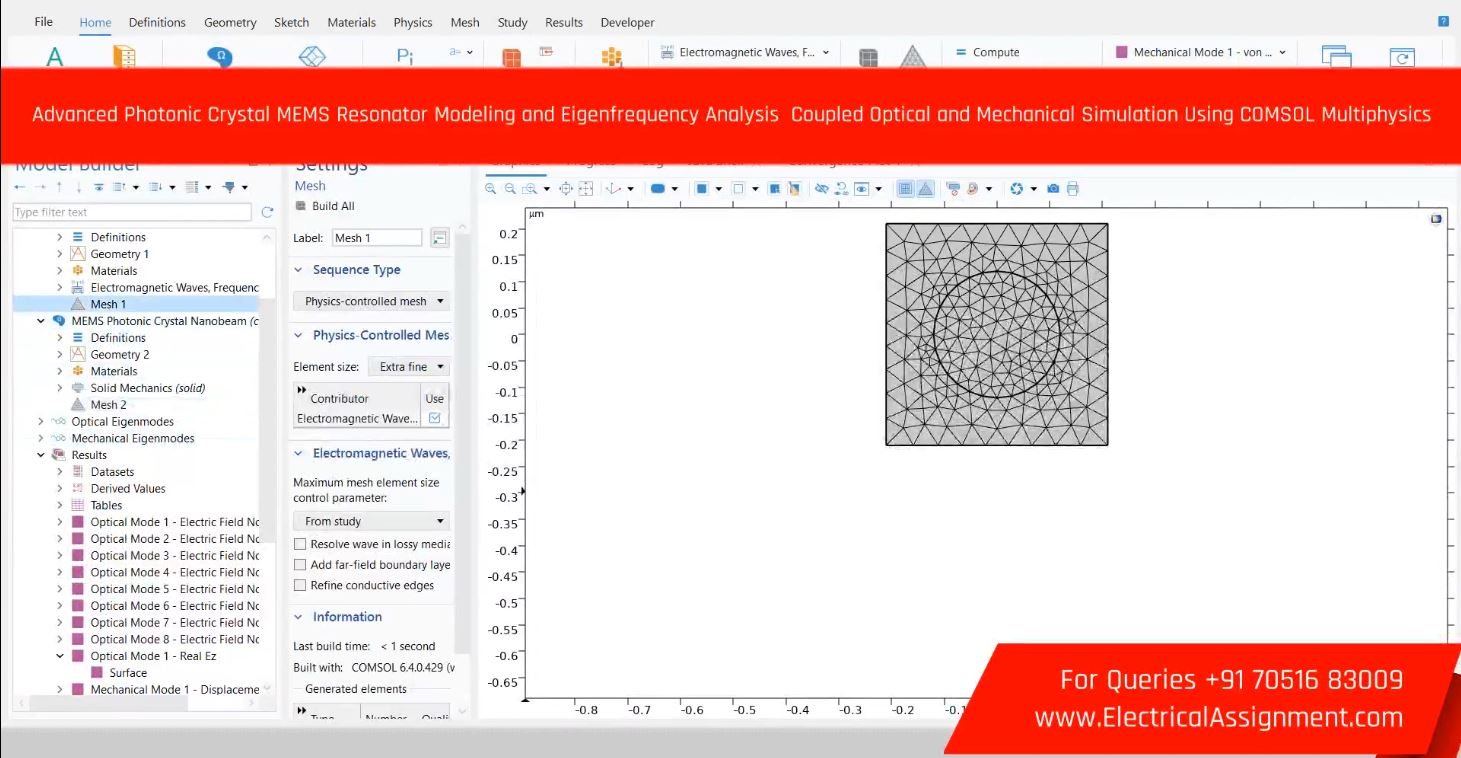
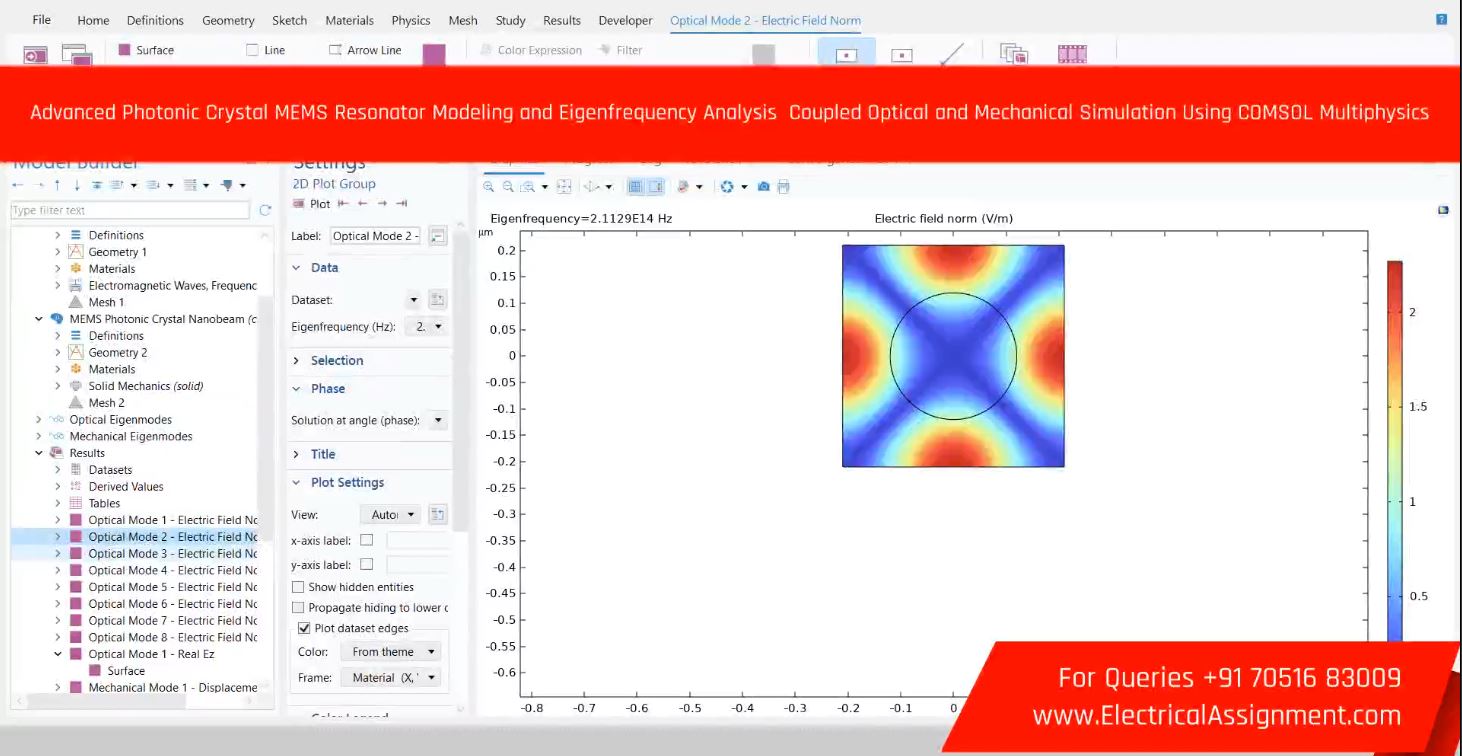
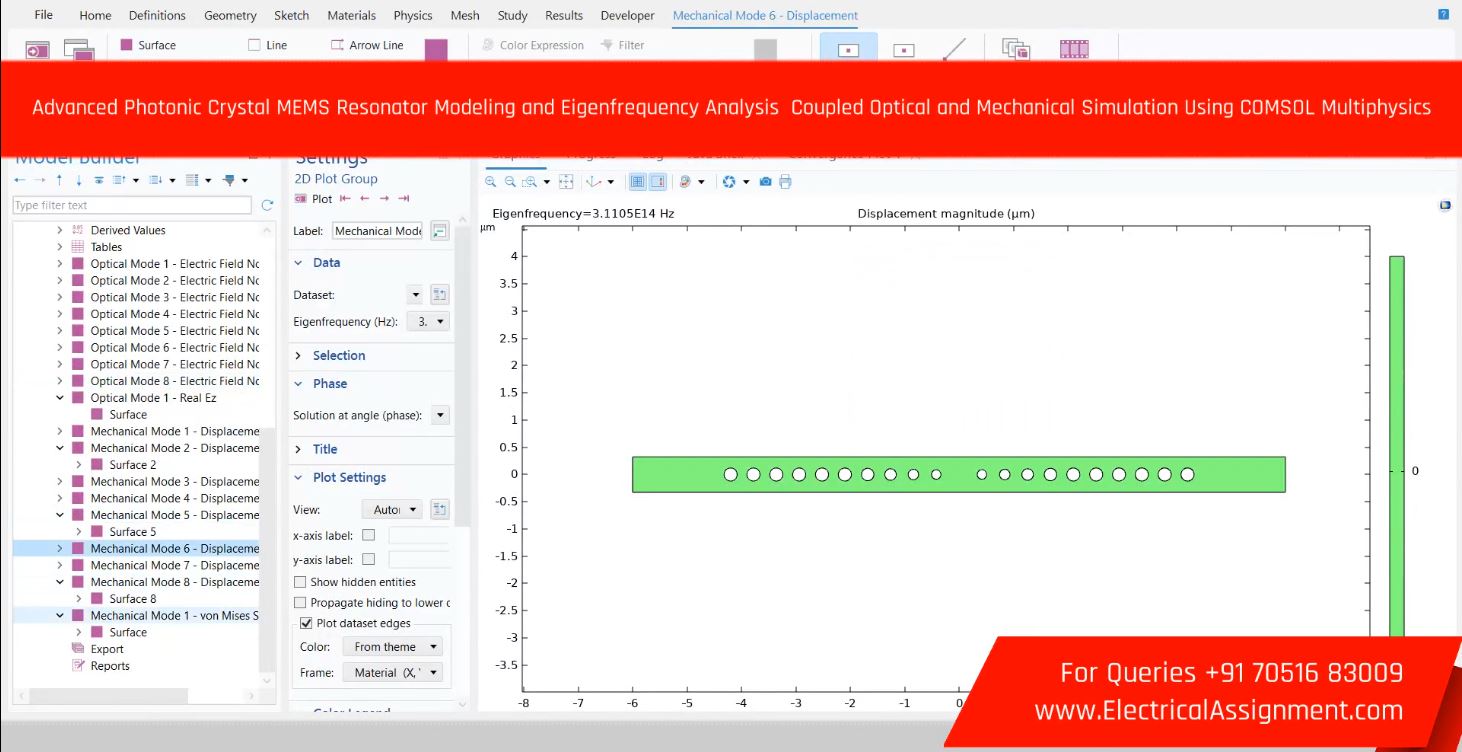
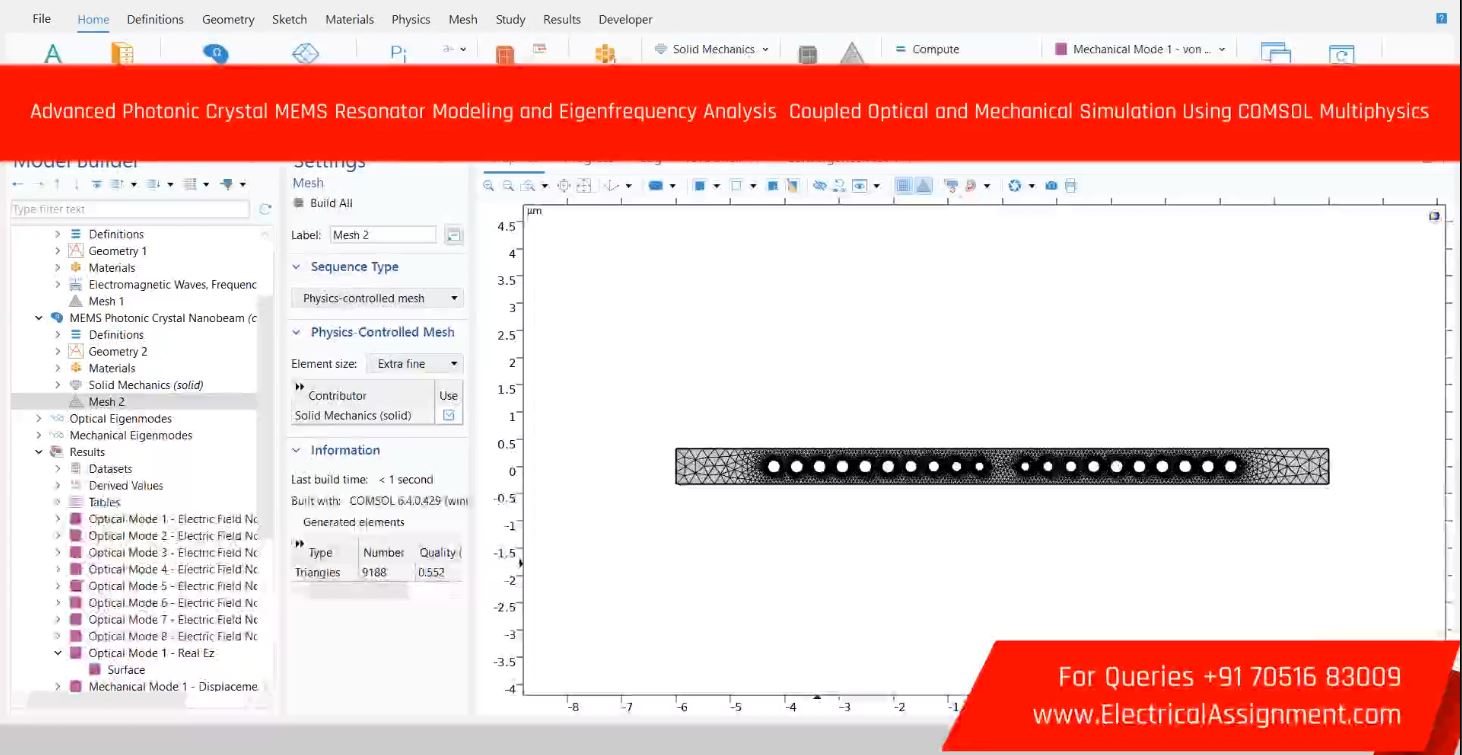
The project images present model architecture, output waveforms, field plots or result snapshots associated with the same technical topic and simulation workflow.
Project Overview and Research Objective
Advanced Photonic Crystal MEMS Resonator Modeling and Eigenfrequency Analysis Coupled Optical and Mechanical Simulation Using COMSOL Multiphysics is positioned as a Semiconductor & Photonics study within COMSOL Projects. Advanced Photonic Crystal MEMS Resonator Modeling and Eigenfrequency Analysis Coupled Optical and Mechanical Simulation Using COMSOL Multiphysics is classified under COMSOL Projects with a technical focus on Semiconductor & Photonics. Using COMSOL Multiphysics, the page concentrates on photonic-crystal MEMS resonator modelling with mechanical eigenmodes, optical confinement and geometry sensitivity. The technical emphasis is on connecting the implemented model to quantitative evidence that can support a thesis, dissertation or comparative research paper. Key title concepts include Photonic, Crystal, MEMS, Resonator, Eigenfrequency, Coupled, Optical.
A suitable research question is: how can the Semiconductor & Photonics approach represented by “Advanced Photonic Crystal MEMS Resonator Modeling and Eigenfrequency Analysis Coupled Optical and Mechanical Simulation Using COMSOL Multiphysics” be evaluated using COMSOL Multiphysics so that voltage deviation and frequency nadir are improved or maintained without creating unacceptable degradation in RoCoF?
The scope is especially relevant to researchers working with COMSOL Multiphysics who need a traceable link between the implemented model, the operating scenarios and the evidence used in the final thesis or paper.
System Architecture and Main Components
For this topic, the model architecture should make the relationship between the research input, the physical or numerical plant and the reported outputs explicit.
- Photonic-crystal lattice/cavity: configure this element so its parameters and role can be traced to the Semiconductor & Photonics objective of Advanced Photonic Crystal MEMS Resonator Modeling and Eigenfrequency Analysis Coupled Optical and Mechanical Simulation Using COMSOL Multiphysics.
- MEMS resonator/support geometry: configure this element so its parameters and role can be traced to the Semiconductor & Photonics objective of Advanced Photonic Crystal MEMS Resonator Modeling and Eigenfrequency Analysis Coupled Optical and Mechanical Simulation Using COMSOL Multiphysics.
- Structural mechanics physics: configure this element so its parameters and role can be traced to the Semiconductor & Photonics objective of Advanced Photonic Crystal MEMS Resonator Modeling and Eigenfrequency Analysis Coupled Optical and Mechanical Simulation Using COMSOL Multiphysics.
- Optical/electromagnetic physics: configure this element so its parameters and role can be traced to the Semiconductor & Photonics objective of Advanced Photonic Crystal MEMS Resonator Modeling and Eigenfrequency Analysis Coupled Optical and Mechanical Simulation Using COMSOL Multiphysics.
- Eigenfrequency/mode studies: configure this element so its parameters and role can be traced to the Semiconductor & Photonics objective of Advanced Photonic Crystal MEMS Resonator Modeling and Eigenfrequency Analysis Coupled Optical and Mechanical Simulation Using COMSOL Multiphysics.
- Displacement and optical-field post-processing: configure this element so its parameters and role can be traced to the Semiconductor & Photonics objective of Advanced Photonic Crystal MEMS Resonator Modeling and Eigenfrequency Analysis Coupled Optical and Mechanical Simulation Using COMSOL Multiphysics.
Simulation and Research Methodology
- Parameterize lattice, defect and support geometry. Record the assumptions and the evidence expected from this step for Advanced Photonic Crystal MEMS Resonator Modeling and Eigenfrequency Analysis Coupled Optical and Mechanical Simulation Using COMSOL Multiphysics.
- Solve mechanical eigenmodes. Record the assumptions and the evidence expected from this step for Advanced Photonic Crystal MEMS Resonator Modeling and Eigenfrequency Analysis Coupled Optical and Mechanical Simulation Using COMSOL Multiphysics.
- Solve optical mode confinement. Record the assumptions and the evidence expected from this step for Advanced Photonic Crystal MEMS Resonator Modeling and Eigenfrequency Analysis Coupled Optical and Mechanical Simulation Using COMSOL Multiphysics.
- Sweep geometry to track sensitivity. Record the assumptions and the evidence expected from this step for Advanced Photonic Crystal MEMS Resonator Modeling and Eigenfrequency Analysis Coupled Optical and Mechanical Simulation Using COMSOL Multiphysics.
- Relate mechanical deformation to optical-response changes. Record the assumptions and the evidence expected from this step for Advanced Photonic Crystal MEMS Resonator Modeling and Eigenfrequency Analysis Coupled Optical and Mechanical Simulation Using COMSOL Multiphysics.
Recommended Study Cases
A thesis or journal-oriented implementation should not rely on a single nominal run. For this project, useful test cases include:
- baseline geometry and boundary conditions
- mesh refinement case
- parameter or material variation
- critical load/flow/field condition
- comparison against a reference or simplified model
Validation Metrics and Thesis Evidence
The recommended validation evidence includes voltage deviation, frequency nadir, RoCoF, settling time. For research use, plots should be accompanied by units, operating conditions and a short explanation of the physical or algorithmic cause of each important change. The final discussion should also explain sensitivity to parameter or material variation, critical load/flow/field condition.
Expected Simulation Outputs
- Mechanical eigenfrequency — interpret this result against the selected operating case and one of the defined validation metrics.
- Mode shapes — interpret this result against the selected operating case and one of the defined validation metrics.
- Optical field distribution — interpret this result against the selected operating case and one of the defined validation metrics.
- Frequency splitting/sensitivity — interpret this result against the selected operating case and one of the defined validation metrics.
- Optomechanical design trends — interpret this result against the selected operating case and one of the defined validation metrics.
Video Summary and Technical Context
The project video for Advanced Photonic Crystal MEMS Resonator Modeling and Eigenfrequency Analysis Coupled Optical and Mechanical Simulation Using COMSOL Multiphysics should be read together with the technical text on this page. The expected workflow begins with the Photonic-crystal lattice/cavity, proceeds through MEMS resonator/support geometry and Structural mechanics physics, and then records Mechanical eigenfrequency, Mode shapes, Optical field distribution. For a research implementation, the important point is not only that the model runs, but that every output is linked to a stated objective, operating case and validation metric.
The video and page together emphasize photonic-crystal MEMS resonator modelling with mechanical eigenmodes, optical confinement and geometry sensitivity. Researchers should retain the model parameters, software version, solver/controller settings and the conditions associated with each plotted result so that the work can be reproduced or extended later.
Research Applications
The modelling approach used in Advanced Photonic Crystal MEMS Resonator Modeling and Eigenfrequency Analysis Coupled Optical and Mechanical Simulation Using COMSOL Multiphysics can be relevant to the following application directions:
- mechanical / thermal design evaluation
- multiphysics device development
- CFD/FEA research and optimization
- engineering design validation before prototyping
PhD Novelty and Publication-Oriented Extensions
A stronger research contribution should extend the baseline topic with a clearly stated limitation, proposed modification and measurable comparison. Project-specific directions include:
- design-of-experiments or surrogate-assisted optimization
- mesh- and parameter-uncertainty quantification
- multiphysics coupling beyond the baseline case
- validation against analytical, experimental or published reference data
International PhD and Postgraduate Research Use
For PhD researchers and postgraduate scholars working internationally, this topic can be adapted to a university proposal, published reference paper or independently defined research gap. The model scope can be aligned with the required software version, parameter set, dataset, disturbance profile, geometry, controller structure and reporting format while preserving reproducibility and clear technical attribution.
Electrical Assignment supports research planning and simulation customization for scholars in Malaysia, UAE, Canada, India, UK, Australia and Germany and other regions. The technical objective remains the same: make the simulation understandable, measurable and defensible rather than relying on screenshots alone.
Technical Scope and Related Concepts
Key concepts connected to this project include Advanced Photonic Crystal MEMS Resonator Modeling and Eigenfrequency Analysis Coupled Optical and Mechanical Simulation Using COMSOL Multiphysics; Semiconductor & Photonics PhD simulation; COMSOL Multiphysics thesis research project; COMSOL Projects simulation for postgraduate research; Photonic, Crystal, MEMS, Resonator, Eigenfrequency, Coupled, Optical engineering simulation; Semiconductor & Photonics methodology and validation. These topics help position the model within its wider engineering research area and support comparison with related methods and applications.
Related Research Articles for This Project
Explore focused articles covering design, optimization, validation, applications and thesis novelty for this same project topic.
Project Media, Research Guides and Related Resources
Projects using related software
More projects in this engineering domain
Explore Other Engineering Project Domains
Academic and Project Content Note
This page provides a representative simulation project overview and research-planning framework. Final implementation, numerical claims and documentation should follow the selected source paper, dataset, equipment ratings, software version and university requirements.
Advanced Photonic Crystal MEMS Resonator Modeling and Eigenfrequency Analysis Coupled Optical and Mechanical Simulation Using COMSOL Multiphysics research questions
What is the research objective of Advanced Photonic Crystal MEMS Resonator Modeling and Eigenfrequency Analysis Coupled Optical and Mechanical Simulation Using COMSOL Multiphysics?
A suitable research question is: how can the Semiconductor & Photonics approach represented by “Advanced Photonic Crystal MEMS Resonator Modeling and Eigenfrequency Analysis Coupled Optical and Mechanical Simulation Using COMSOL Multiphysics” be evaluated using COMSOL Multiphysics so that voltage deviation and frequency nadir are improved or maintained without creating unacceptable degradation in RoCoF?
Which outputs should be validated for this project?
The recommended evidence includes voltage deviation, frequency nadir, RoCoF, settling time, active/reactive power sharing, branch or converter loading. The exact set should be aligned with the selected paper, model and research question.
Which operating cases should be tested?
A robust study can include baseline geometry and boundary conditions, mesh refinement case, parameter or material variation, critical load/flow/field condition, comparison against a reference or simplified model. The same cases should be applied to baseline and proposed methods where a comparison is claimed.
How can Advanced Photonic Crystal MEMS Resonator Modeling and Eigenfrequency Analysis Coupled Optical and Mechanical Simulation Using COMSOL Multiphysics be extended for PhD or journal research?
Relevant directions include design-of-experiments or surrogate-assisted optimization, mesh- and parameter-uncertainty quantification, multiphysics coupling beyond the baseline case, validation against analytical, experimental or published reference data. The extension should address a defined literature limitation and be validated quantitatively.
Which software is associated with this project?
The project is associated with COMSOL Multiphysics in the Semiconductor & Photonics area. Software version, solver settings and dependencies should be recorded for reproducibility.