
Watch: Advanced Thermal Runaway Modeling and Safety Enhancement of Electric Vehicle Lithium-Ion Battery Packs COMSOL Multiphysics Simulation
The project video starts automatically in muted mode where the browser permits autoplay. Use the player controls to enable sound, pause, seek or replay while reviewing the model workflow and simulation results.
Simulation Images and Output Snapshots
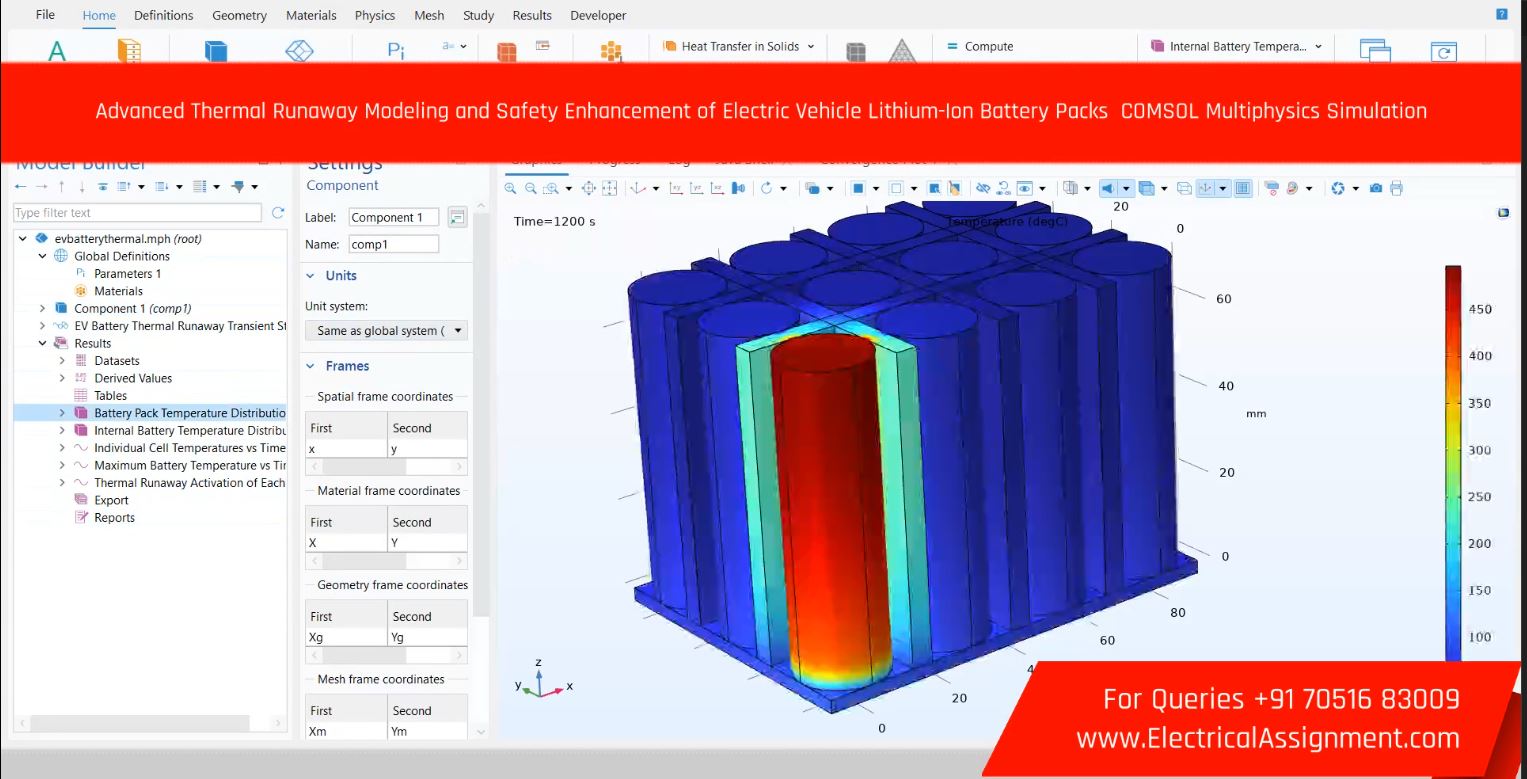
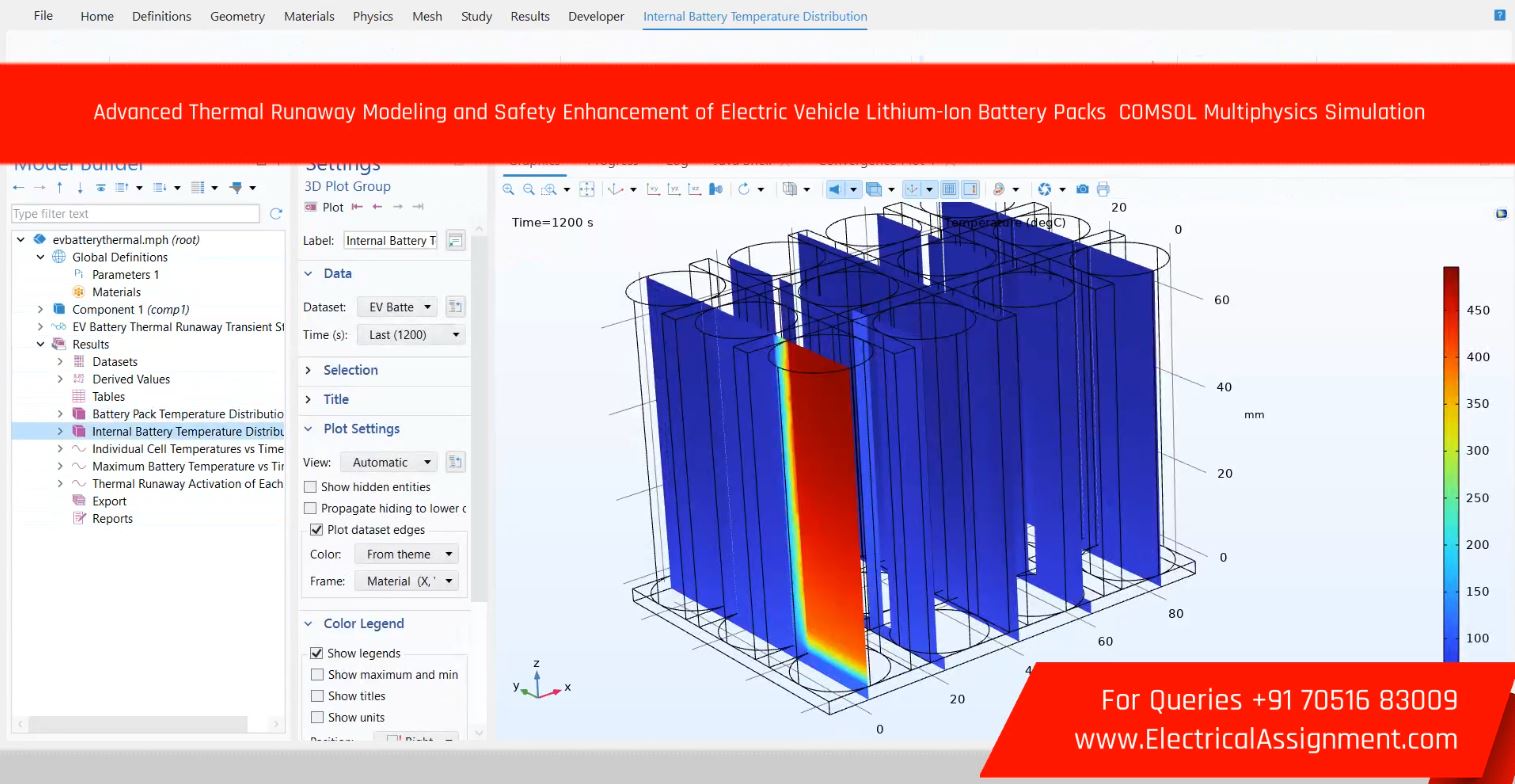
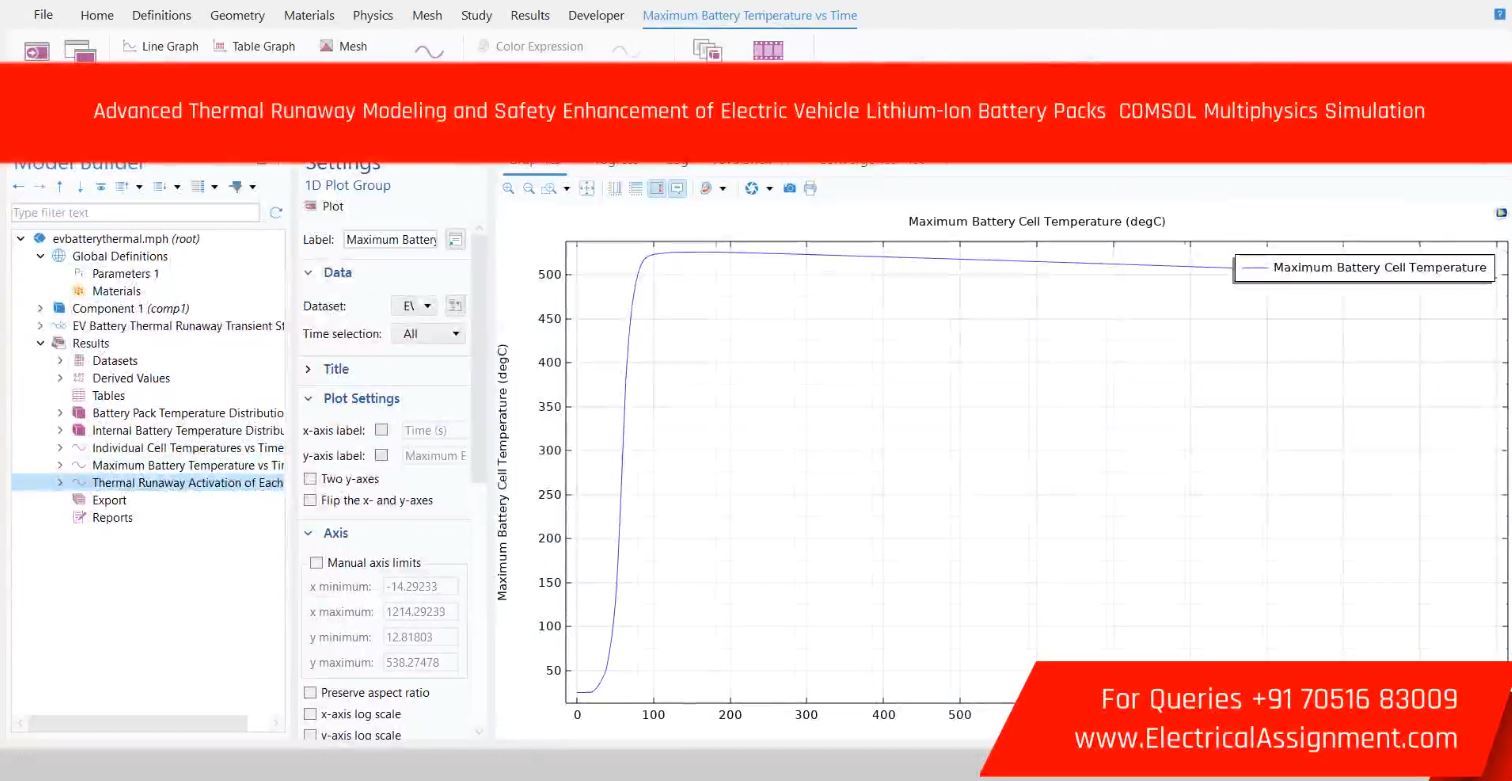
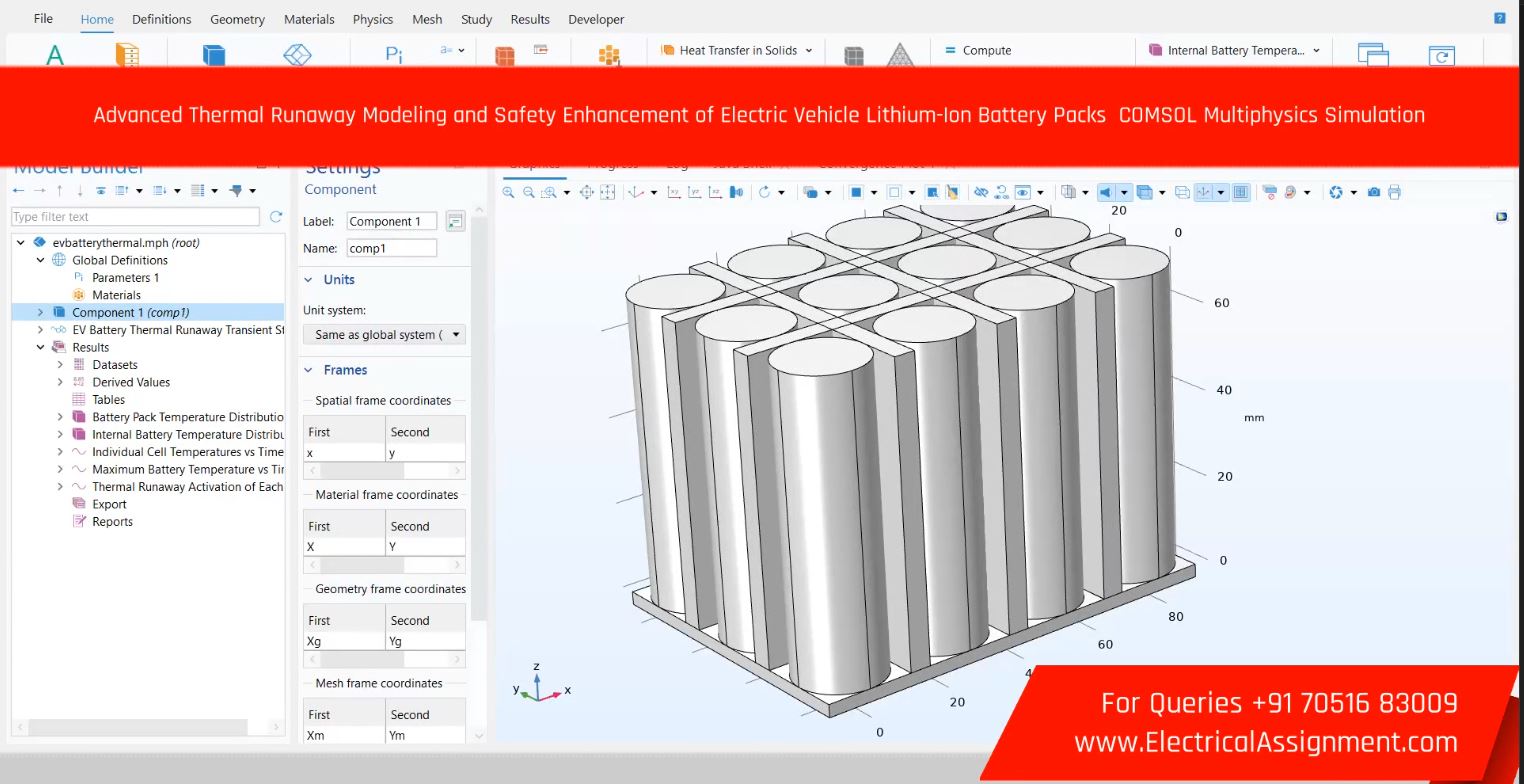
The project images present model architecture, output waveforms, field plots or result snapshots associated with the same technical topic and simulation workflow.
Project Overview and Research Objective
Advanced Thermal Runaway Modeling and Safety Enhancement of Electric Vehicle Lithium-Ion Battery Packs COMSOL Multiphysics Simulation is positioned as a Battery, Fuel Cell & Electrochemistry study within COMSOL Projects. Advanced Thermal Runaway Modeling and Safety Enhancement of Electric Vehicle Lithium-Ion Battery Packs COMSOL Multiphysics Simulation is classified under COMSOL Projects with a technical focus on Battery, Fuel Cell & Electrochemistry. Using COMSOL Multiphysics, the page concentrates on battery thermal-runaway initiation, propagation and pack-level safety mitigation in COMSOL Multiphysics. This project examines how the selected engineering architecture behaves when its principal operating variables are changed in a controlled simulation study. Key title concepts include Thermal, Runaway, Safety, Enhancement, Electric, Vehicle, Lithium-Ion.
A suitable research question is: how can the Battery, Fuel Cell & Electrochemistry approach represented by “Advanced Thermal Runaway Modeling and Safety Enhancement of Electric Vehicle Lithium-Ion Battery Packs COMSOL Multiphysics Simulation” be evaluated using COMSOL Multiphysics so that SOC estimation or tracking error and charge/discharge power are improved or maintained without creating unacceptable degradation in voltage deviation?
The scope is especially relevant to researchers working with COMSOL Multiphysics who need a traceable link between the implemented model, the operating scenarios and the evidence used in the final thesis or paper.
System Architecture and Main Components
For this topic, the model architecture should make the relationship between the research input, the physical or numerical plant and the reported outputs explicit.
- Battery-cell domains: configure this element so its parameters and role can be traced to the Battery, Fuel Cell & Electrochemistry objective of Advanced Thermal Runaway Modeling and Safety Enhancement of Electric Vehicle Lithium-Ion Battery Packs COMSOL Multiphysics Simulation.
- Temperature-dependent materials: configure this element so its parameters and role can be traced to the Battery, Fuel Cell & Electrochemistry objective of Advanced Thermal Runaway Modeling and Safety Enhancement of Electric Vehicle Lithium-Ion Battery Packs COMSOL Multiphysics Simulation.
- Runaway heat-source model: configure this element so its parameters and role can be traced to the Battery, Fuel Cell & Electrochemistry objective of Advanced Thermal Runaway Modeling and Safety Enhancement of Electric Vehicle Lithium-Ion Battery Packs COMSOL Multiphysics Simulation.
- Thermal contacts and enclosure: configure this element so its parameters and role can be traced to the Battery, Fuel Cell & Electrochemistry objective of Advanced Thermal Runaway Modeling and Safety Enhancement of Electric Vehicle Lithium-Ion Battery Packs COMSOL Multiphysics Simulation.
- Cooling/barrier mitigation: configure this element so its parameters and role can be traced to the Battery, Fuel Cell & Electrochemistry objective of Advanced Thermal Runaway Modeling and Safety Enhancement of Electric Vehicle Lithium-Ion Battery Packs COMSOL Multiphysics Simulation.
- Temperature and heat-flux probes: configure this element so its parameters and role can be traced to the Battery, Fuel Cell & Electrochemistry objective of Advanced Thermal Runaway Modeling and Safety Enhancement of Electric Vehicle Lithium-Ion Battery Packs COMSOL Multiphysics Simulation.
Simulation and Research Methodology
- Validate nominal heating first. Record the assumptions and the evidence expected from this step for Advanced Thermal Runaway Modeling and Safety Enhancement of Electric Vehicle Lithium-Ion Battery Packs COMSOL Multiphysics Simulation.
- Define a documented runaway trigger. Record the assumptions and the evidence expected from this step for Advanced Thermal Runaway Modeling and Safety Enhancement of Electric Vehicle Lithium-Ion Battery Packs COMSOL Multiphysics Simulation.
- Resolve mesh and thermal contacts near interfaces. Record the assumptions and the evidence expected from this step for Advanced Thermal Runaway Modeling and Safety Enhancement of Electric Vehicle Lithium-Ion Battery Packs COMSOL Multiphysics Simulation.
- Simulate propagation across neighboring cells. Record the assumptions and the evidence expected from this step for Advanced Thermal Runaway Modeling and Safety Enhancement of Electric Vehicle Lithium-Ion Battery Packs COMSOL Multiphysics Simulation.
- Compare mitigation cases under identical triggers. Record the assumptions and the evidence expected from this step for Advanced Thermal Runaway Modeling and Safety Enhancement of Electric Vehicle Lithium-Ion Battery Packs COMSOL Multiphysics Simulation.
Recommended Study Cases
A thesis or journal-oriented implementation should not rely on a single nominal run. For this project, useful test cases include:
- nominal charge/discharge operation
- step change in load or charging demand
- different initial SOC conditions
- power or current limit activation
- a stressed thermal or parameter-variation case
Validation Metrics and Thesis Evidence
The recommended validation evidence includes SOC estimation or tracking error, charge/discharge power, voltage deviation, current ripple. The strongest validation comes from repeating identical test cases for the reference and proposed methods, then explaining why the measured differences occur. The final discussion should also explain sensitivity to different initial SOC conditions, power or current limit activation.
Expected Simulation Outputs
- Cell temperature histories — interpret this result against the selected operating case and one of the defined validation metrics.
- Peak temperature — interpret this result against the selected operating case and one of the defined validation metrics.
- Propagation delay — interpret this result against the selected operating case and one of the defined validation metrics.
- Inter-cell heat flux — interpret this result against the selected operating case and one of the defined validation metrics.
- Mitigation effectiveness — interpret this result against the selected operating case and one of the defined validation metrics.
Video Summary and Technical Context
The project video for Advanced Thermal Runaway Modeling and Safety Enhancement of Electric Vehicle Lithium-Ion Battery Packs COMSOL Multiphysics Simulation should be read together with the technical text on this page. The expected workflow begins with the Battery-cell domains, proceeds through Temperature-dependent materials and Runaway heat-source model, and then records Cell temperature histories, Peak temperature, Propagation delay. For a research implementation, the important point is not only that the model runs, but that every output is linked to a stated objective, operating case and validation metric.
The video and page together emphasize battery thermal-runaway initiation, propagation and pack-level safety mitigation in COMSOL Multiphysics. Researchers should retain the model parameters, software version, solver/controller settings and the conditions associated with each plotted result so that the work can be reproduced or extended later.
Research Applications
The modelling approach used in Advanced Thermal Runaway Modeling and Safety Enhancement of Electric Vehicle Lithium-Ion Battery Packs COMSOL Multiphysics Simulation can be relevant to the following application directions:
- grid-scale and microgrid energy storage
- EV battery management
- renewable-energy smoothing and peak management
- battery-control and state-estimation research
PhD Novelty and Publication-Oriented Extensions
A stronger research contribution should extend the baseline topic with a clearly stated limitation, proposed modification and measurable comparison. Project-specific directions include:
- hybrid SOC/SOH estimation
- degradation-aware energy management
- thermal-constrained charging or dispatch
- multi-objective sizing/control with lifecycle and grid metrics
International PhD and Postgraduate Research Use
For PhD researchers and postgraduate scholars working internationally, this topic can be adapted to a university proposal, published reference paper or independently defined research gap. The model scope can be aligned with the required software version, parameter set, dataset, disturbance profile, geometry, controller structure and reporting format while preserving reproducibility and clear technical attribution.
Electrical Assignment supports research planning and simulation customization for scholars in Australia, Germany, France, Malaysia, UAE, Canada and India and other regions. The technical objective remains the same: make the simulation understandable, measurable and defensible rather than relying on screenshots alone.
Technical Scope and Related Concepts
Key concepts connected to this project include Advanced Thermal Runaway Modeling and Safety Enhancement of Electric Vehicle Lithium-Ion Battery Packs COMSOL Multiphysics Simulation; Battery, Fuel Cell & Electrochemistry PhD simulation; COMSOL Multiphysics thesis research project; COMSOL Projects simulation for postgraduate research; Thermal, Runaway, Safety, Enhancement, Electric, Vehicle, Lithium-Ion engineering simulation; Battery, Fuel Cell & Electrochemistry methodology and validation. These topics help position the model within its wider engineering research area and support comparison with related methods and applications.
Related Research Articles for This Project
Explore focused articles covering design, optimization, validation, applications and thesis novelty for this same project topic.
Project Media, Research Guides and Related Resources
More Battery, Fuel Cell & Electrochemistry projects
Projects using related software
More projects in this engineering domain
Explore Other Engineering Project Domains
Academic and Project Content Note
This page provides a representative simulation project overview and research-planning framework. Final implementation, numerical claims and documentation should follow the selected source paper, dataset, equipment ratings, software version and university requirements.
Advanced Thermal Runaway Modeling and Safety Enhancement of Electric Vehicle Lithium-Ion Battery Packs COMSOL Multiphysics Simulation research questions
What is the research objective of Advanced Thermal Runaway Modeling and Safety Enhancement of Electric Vehicle Lithium-Ion Battery Packs COMSOL Multiphysics Simulation?
A suitable research question is: how can the Battery, Fuel Cell & Electrochemistry approach represented by “Advanced Thermal Runaway Modeling and Safety Enhancement of Electric Vehicle Lithium-Ion Battery Packs COMSOL Multiphysics Simulation” be evaluated using COMSOL Multiphysics so that SOC estimation or tracking error and charge/discharge power are improved or maintained without creating unacceptable degradation in voltage deviation?
Which outputs should be validated for this project?
The recommended evidence includes SOC estimation or tracking error, charge/discharge power, voltage deviation, current ripple, energy efficiency, thermal or operating-limit margin. The exact set should be aligned with the selected paper, model and research question.
Which operating cases should be tested?
A robust study can include nominal charge/discharge operation, step change in load or charging demand, different initial SOC conditions, power or current limit activation, a stressed thermal or parameter-variation case. The same cases should be applied to baseline and proposed methods where a comparison is claimed.
How can Advanced Thermal Runaway Modeling and Safety Enhancement of Electric Vehicle Lithium-Ion Battery Packs COMSOL Multiphysics Simulation be extended for PhD or journal research?
Relevant directions include hybrid SOC/SOH estimation, degradation-aware energy management, thermal-constrained charging or dispatch, multi-objective sizing/control with lifecycle and grid metrics. The extension should address a defined literature limitation and be validated quantitatively.
Which software is associated with this project?
The project is associated with COMSOL Multiphysics in the Battery, Fuel Cell & Electrochemistry area. Software version, solver settings and dependencies should be recorded for reproducibility.